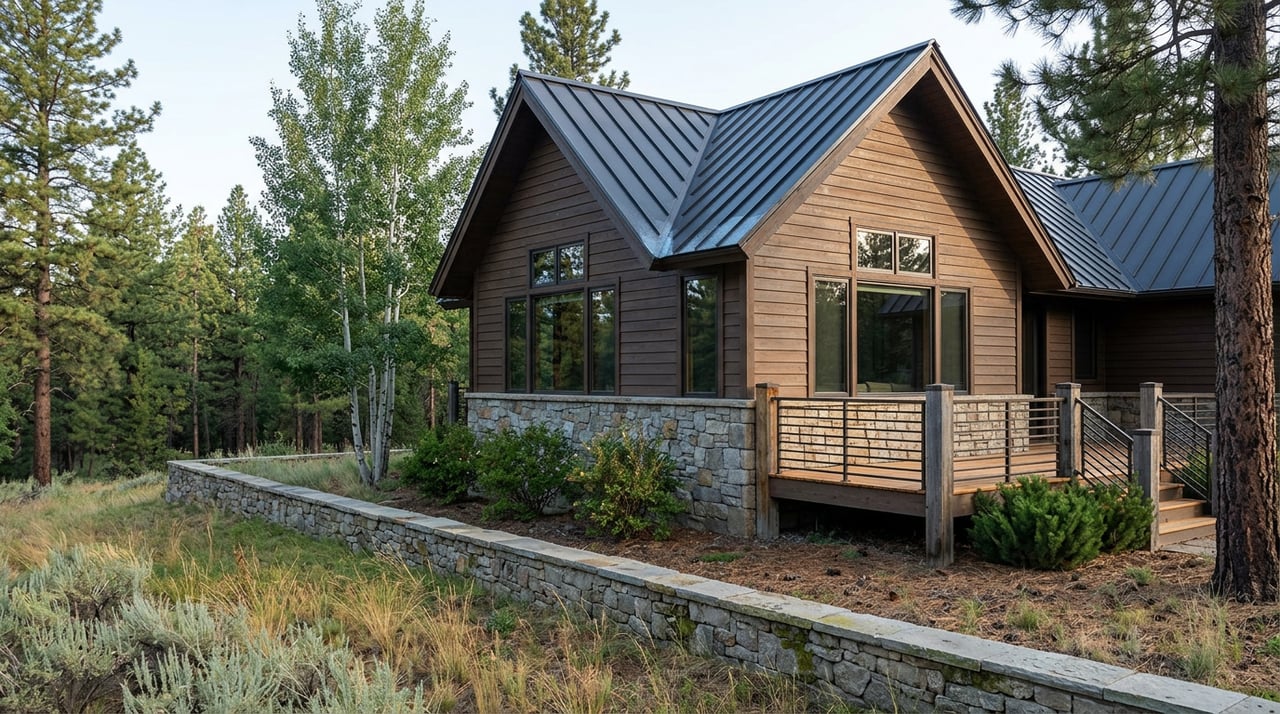
Read enough Loghill Village listings and you'll see the same phrase: voluntary HOA. It reads like good news. No mandatory dues, no board telling you what color to paint your fascia, no fight over an assessment you didn't vote for. For a buyer coming from a subdivision with a mandatory association, "voluntary" sounds like fewer rules.
It isn't. It means fewer rules from one body and the same rules from another, and the second body is the one that actually decides whether you get a building permit.
Two Organizations, One Confusing Name
Loghill Village has a Home and Property Owners Association, the LHVH&POA, and its own bylaws say membership is voluntary. Any property owner in the community is eligible to join, dues are modest, and nobody is compelled to pay them or sit on the board.
But Units I, II, and IV, which cover most of the platted lots in Loghill Village, also carry recorded Protective Covenants. Those covenants created a separate Architectural Control Committee, or ACC, for each unit. The ACC is not optional. Written ACC approval is required before Ouray County will issue a building permit and before an owner can legally begin tree removal, excavation, driveway construction, remodeling, or additions to any structure on the lot.
So a buyer can decline to join the voluntary association, skip the newsletter, and never attend an annual meeting, and still be fully bound by the ACC's review process the moment a shovel goes in the ground. The association's own bylaws are direct about the voluntary piece:
Membership in the Association shall be on a voluntary basis.
That sentence is true and it is also incomplete on its own. It describes the social HOA, not the design authority that controls construction.
What the ACC Actually Reviews
The ACC isn't a rubber stamp. Its published criteria and standards for Units I, II, and IV cover specifics that show up in real building plans, not boilerplate:
- Minimum dwelling size of 1,000 square feet for a one-story home and 1,500 square feet for anything taller, unless the committee approves an exception
- No chain-link, stockade-style, or barbed wire fencing, and any approved fence has to be built so it won't trap or injure deer and other wildlife passing through
- Exterior lighting limited to fully shielded fixtures with roughly a 40-watt equivalent bulb, with the bulb itself not visible below the fixture
- Horses and llamas require ACC approval and must be kept more than 100 feet from any lot line
- Highly reflective metal roofing is not allowed, and any change to previously approved exterior colors or materials needs a new ACC sign-off
None of that is enforced by the voluntary HOA. It's enforced through the recorded covenants, with the county's own permit process as the backstop. Here's the practical difference for someone evaluating a Loghill Village lot before closing:
| LHVH&POA (the Association) | ACC (per unit) | |
|---|---|---|
| Membership | Voluntary | Automatic under the recorded covenants for Units I, II, IV |
| Current dues | $35 a year, per the association's own posted minutes | No separate membership fee, but plan review is required for any construction |
| What it controls | Newsletter, social events, some shared infrastructure discussions | Building plans, additions, fencing, lighting, exterior changes, tree removal, driveways |
| What happens if you skip it | You miss meetings and updates | You cannot get a county building permit |
The takeaway for a buyer isn't that Loghill Village is over-regulated. Compared to many resort-area subdivisions, it's light. The takeaway is that "voluntary HOA" on a listing sheet answers the wrong question. The right question is whether your lot sits in Unit I, II, or IV, and whether you've pulled the ACC criteria before you finalize a build or remodel budget.
Why Some Loghill Roads Are Paved and Others Are Gravel
If you've driven Loghill Village, you've noticed the pattern. Ponderosa Drive and the other main roads are paved. A lot of the cul-de-sacs aren't.
That split has a specific origin. In 2005, property owners voted on a special assessment to pave the community's main roads, which had been maintained as dirt and treated with magnesium chloride for dust control, at a traffic volume the county itself said was becoming difficult to keep grading and dust-treating properly. The measure passed with a 71 percent yes vote. The assessment came to $3,073.50 per lot, aimed at raising roughly $1.4 million, with owners able to pay in full by April 2005 or spread payments over time at about $271 a year. The county sold roughly $1,085,000 in bonds that May to help cover the work, and the contract ultimately paved about 9.5 miles of the neighborhood's main roads using a special high-altitude asphalt mix, one soft enough for Loghill's elevation that it wouldn't hold up in a hotter, lower-elevation town like Montrose.
Most cul-de-sacs were left out of that scope. Paving them would have roughly doubled the project cost, and the association's own history of the project notes those side roads see far less traffic and fewer maintenance problems than the main routes.
For a buyer, this matters beyond curb appeal. A lot on an unpaved cul-de-sac isn't a red flag, but it does mean the 2005 assessment never applied to that stretch of road, and any future paving there would be a new conversation with the association, not something already funded and built. Worth asking directly: was this specific road included in the 2005 project, and who currently maintains it.
Covenants Expire. Renewal Isn't Automatic.
The Protective Covenants that create ACC authority aren't permanent by default. They come with expiration and renewal provisions, and getting a renewal passed is genuinely difficult. When Unit I's covenants were approaching expiration, the association's own account of the process describes it as a months-long undertaking involving a small group of residents working through the review, the drafting, and the outreach needed to get enough lot owners to actually respond and approve the extension in 2016.
That's not a criticism of the community. It's a description of how these things work in a low-density, part-time-resident neighborhood where a lot of owners aren't checking mail from the association year-round. But it means a buyer or an agent doing due diligence should ask a very specific question before closing: when do this unit's covenants next come up for renewal, and has that renewal already happened. If it hasn't, the ACC's authority over that lot is tied to a process that depends on volunteer effort and owner turnout, not a fixed government calendar.
If You're Buying With a Short-Term Rental in Mind
Loghill Village sits in unincorporated Ouray County, so short-term rentals here run through the county's Land Use Department, not through the voluntary HOA or the ACC. The county's short-term rental permitting is capped by type, currently up to 50 Type 1 permits, 50 Type 2 permits, and 25 Type 3 permits under the county's STR ordinance. That's a separate track entirely from HOA membership and ACC design review, and it runs on its own application and waitlist process through the Land Use Department. For a fuller walk-through of how city-versus-county short-term rental rules differ and what the paperwork involves, we've laid it out in our guide to Ouray short-term rental rules.
What to Confirm Before You Close
- Which unit the lot sits in (I, II, or IV) and whether the recorded covenants there are currently active or approaching a renewal deadline
- Whether the ACC has an active Pre-Construction Approval Form on file for any planned building, remodeling, or fencing
- Whether the specific road frontage was part of the 2005 paving project or remains gravel
- Whether you intend to operate the property as a short-term rental, and if so, the current status of county permit availability
A Few Direct Questions
Do I have to join the Loghill Village HOA to buy here? No. Membership in the LHVH&POA is voluntary under its own bylaws. You are not required to pay dues or attend meetings to own property in the community.
Does skipping the HOA mean I skip design review too? No. If your lot is in Unit I, II, or IV, the Architectural Control Committee's approval is required before Ouray County will issue a building permit, regardless of your HOA membership status.
Are all the roads in Loghill Village paved? No. The main through-roads were paved following a 2005 special assessment. Many cul-de-sacs were left gravel to keep project costs down and remain that way today.
Buying land or a home in a community like Loghill Village means understanding which rules are social and which ones are structural, and where a low profile HOA can still sit behind a very real design-review process. Amanda F Swain works this stretch of the San Juan Mountain corridor closely enough to walk you through exactly which one applies to the lot you're considering, before you write an offer, not after.