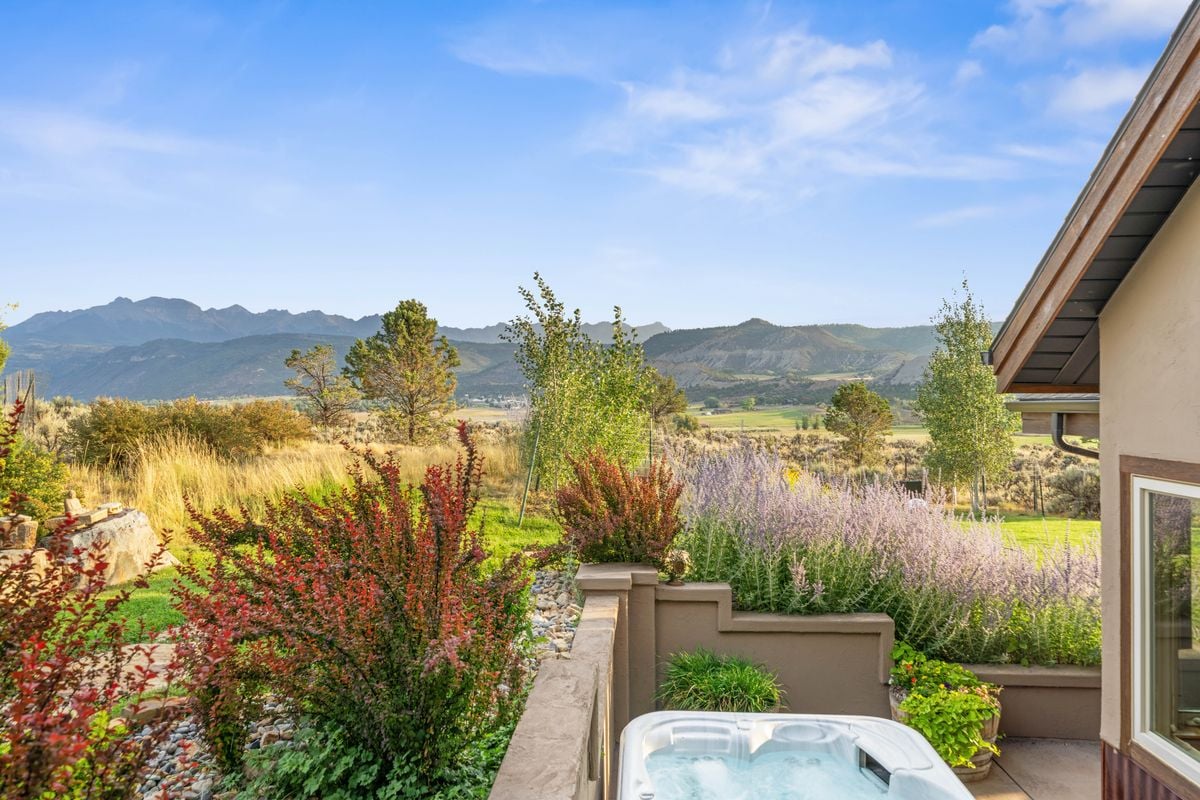
Stand on thirty-five acres outside Ridgway and the property feels boundless. No fence line in sight, sky in every direction, maybe a fold of sagebrush hiding the nearest neighbor. It's the version of Colorado that sells itself.
But the real edges of that parcel were drawn years before you toured it, and they have nothing to do with the survey stakes. A well permit somewhere in a state database decides what the water on that land is legally for. A septic permit decides how many bedrooms the house can have. A wildfire mitigation review decides how close to the ridge you can build and how much cash sits in escrow while you prove it. And a cap most buyers have never heard of decides whether the solar array in your head is even possible. None of these show up on the plat map. All of them are already fixed by the time you make an offer.
The Well Permit Decides What the Water Is For, Not Just Where It Comes From
Inside the Town of Ridgway or the City of Ouray, water is simple: you tap into the municipal system and pay the fee. Step outside either boundary, which is most of the land buyers are actually looking at, and the county's own guidance is direct that water comes from one of two places: an individual well or a water district. If a parcel sits inside a district's service area, the district sets availability and fees. If it doesn't, you're drilling, and the well permit that comes back from the state's Division of Water Resources office in Montrose will specify exactly what that water can legally be used for.
That's the part buyers skip. A permit can restrict you to household use only. It can allow domestic use but exclude livestock. It can require you to augment your supply if you want fire protection capacity. If your plan for the land includes horses, a garden that needs more than a hose, or a stock tank, the well permit's use class is the document that tells you whether that plan is legal, not the listing description.
Location | Water Source | Who Administers It | What It Actually Allows |
|---|---|---|---|
Inside Town of Ridgway | Municipal tap | Town of Ridgway Public Works | Standard service, no use-class question |
Inside City of Ouray | Municipal tap | City of Ouray | Standard service |
Unincorporated county, in a water district | District water | Local water district | District sets availability and fees |
Unincorporated county, no district | Individual well | State DWR, Montrose office | Permit type dictates use: household only, domestic plus livestock, or augmented |
Before you write an offer on anything outside town limits, ask for the well permit number and pull it. It takes a phone call, and it tells you more about what you can actually do on the land than the acreage figure does.
Your Septic Permit Already Set the Bedroom Count
Septic sizing in Colorado runs on bedrooms, not bathrooms. A system permitted for a three-bedroom footprint doesn't stretch to accommodate a fourth bedroom you add later, no matter how the square footage works out. If you're buying land with an existing system, or inheriting one on a resale, the number on that permit is the ceiling on how the house gets built or expanded.
Ouray County adds two more layers most out-of-state buyers don't expect. First, the county's land use code requires that any OWTS serving a dwelling unit be designed by a Colorado licensed professional engineer, full stop, regardless of lot size or elevation. Second, statewide rule sits on top of that: any septic system installed above 8,000 feet needs an engineered design as a baseline requirement. Given how much buildable land around Ridgway and Ouray sits above that line, this isn't a rare edge case. It's closer to the default.
The setback numbers matter too, and they're more specific than the generic state minimums you'll find in most online guides. Ouray County's own buyer brochure sets septic setbacks at 10 feet from lot lines, 20 feet from dwellings, and 100 feet from any well, including a neighbor's. Confirm those distances against the actual site plan before you assume a building envelope works.
The Wildfire Deposit Nobody Budgets For
Ouray County's Wildfire Mitigation Regulations, revised in 2020 under Section 16 of the land use code, attach directly to new building permits. If the county determines your site needs defensible space, you sign an Affidavit of Compliance and post a refundable deposit equal to 1 percent of your estimated project valuation. On a $1 million build, that's a $10,000 hold, refunded once the defensible space work is verified within a year of your certificate of occupancy.
The design requirements underneath that deposit are specific: Class-A fire-resistant roofing, ignition-resistant siding, 1/8-inch vent screens, spark arrestors, a hardened five-foot zone around the structure, and driveway grades that can't exceed 12 percent. The county also recommends keeping structures at least 150 feet from high wildfire risk topographic features like ravines and gullies, since terrain like that accelerates wind and fire behavior in ways flat ground doesn't. None of this is optional scenery. It's underwriting on the permit itself, and it changes both your construction budget and your site plan before ground gets broken.
Fifty Slots, Countywide, First Come First Served
Here's the constraint most land buyers never think to ask about until they're deep into design: San Miguel Power Association, the cooperative serving Ridgway, Ouray, and the surrounding communities, offers a true net metering program that banks your surplus solar generation and pays out the balance annually. It's a genuinely favorable structure. It's also capped at 50 customers territory-wide, first come, first served, across a service area that stretches from Ridgway and Ouray through Telluride, Norwood, Silverton, Nucla, and Naturita.
That cap matters more this year than last. SMPA raised rates on December 15, 2025, largely in response to a 7.2 percent jump in wholesale power costs from Tri-State, which makes generating your own power more valuable than it was twelve months ago, right as the enrollment window tightens. If part of your reason for buying acreage near Ridgway is a self-sufficient power setup, don't assume a net-metering slot is waiting for you. Call SMPA and ask how many of the 50 spots are currently filled before you finalize a solar plan, not after your builder has already ordered panels.
What This Means If You're Under Contract Right Now
Every one of these permits was decided before you existed as a buyer, and every one of them is far cheaper to confirm now than to fix later. If you're already in due diligence on a parcel near Ridgway, work the sequence in this order:
- Confirm whether the parcel is inside Town of Ridgway limits or in unincorporated Ouray County. That single fact determines your water source, your building official, and your permitting path.
- Call SMPA and ask how many net-metering slots remain before you commit to a solar-dependent design.
- Pull the well permit and read the use class. Household only, domestic plus livestock, and augmented supply are three very different documents.
- Request the septic permit file, confirm the bedroom count it was designed for, and check the parcel's elevation against the 8,000-foot engineered-system threshold.
- Ask the County Planner whether the site triggers a Section 16 wildfire mitigation review, and if so, get the estimated deposit in writing before you finalize your construction budget.
None of this is legal advice, and none of it replaces a conversation with a licensed septic engineer, a title company, or the Ouray County Land Use Department directly. But it's the difference between finding out about a constraint during your inspection period and finding out about it after your builder has already poured a foundation.
Common Questions
Does every new home near Ridgway need an engineered septic system? Statewide, any system above 8,000 feet in elevation requires an engineered design. Separately, Ouray County's own land use code requires that any OWTS serving a dwelling unit be designed by a Colorado licensed professional engineer, regardless of elevation. Most buildable parcels in the area end up covered by one rule or the other.
Is Town of Ridgway municipal water available outside town limits? No. Municipal water in this corridor exists only inside the Town of Ridgway and the City of Ouray. Everywhere else in the county, you're on an individual well or a water district, and the well permit's use class determines what you can legally do with that water.
If SMPA's net metering program is full when I buy, can I still go solar? You can still install solar for your own use. What you may not get is true net metering, the program that banks surplus generation and pays out annually, since that's capped at 50 accounts territory-wide. Confirm current enrollment with SMPA before you build a budget around getting paid for excess power.
If you're evaluating raw land or an existing home near Ridgway right now, I'd rather walk through the well permit, the septic file, and the wildfire review with you before you write an offer than have you discover any of it during your inspection period. Amanda F. Swain works this exact corridor, parcel by parcel, and can pull the permit history alongside you. Explore My Properties to see what's currently available, or reach out directly and we'll go through the paperwork together.